Dna Model Online Interactive Easy Middle School
Summary
Students reinforce their knowledge that DNA is the genetic cloth for all living things by modeling information technology using toothpicks and gumdrops that represent the four biochemicals (adenine, thiamine, guanine, and cytosine) that pair with each other in a specific pattern, making a double helix. They investigate specific DNA sequences that code for certain physical characteristics such equally eye and hair color. Educatee teams trade Dna "strands" and de-code the genetic sequences to determine the physical characteristics (phenotype) displayed past the strands (genotype) from other groups. Students extend their knowledge to acquire about Deoxyribonucleic acid fingerprinting and recognizing DNA alterations that may result in genetic disorders.This applied science curriculum aligns to Side by side Generation Scientific discipline Standards (NGSS).
Engineering Connectedness
Biomedical engineers study which specific Dna sequences code for sure characteristics as they investigate genetic disorders such every bit color blindness, Downwardly syndrome, cystic fibrosis and hemophilia. Engineers develop technologies to recognize sure DNA mutations. Biomedical engineers study genes and DNA to develop technologies that could dispense or supplant genes that are damaged or missing. Gene therapy has many implications for the diagnosis, treatment and possibly prevention of human diseases such equally cancer, cystic fibrosis and middle disease.
Learning Objectives
After this action, students should be able to:
- Explain that certain Deoxyribonucleic acid sequences code for specific characteristics.
- List several types of engineers and applied science technologies that rely on DNA sequences.
- Investigate basic gene sequences to determine the genotype and phenotype of an private.
Educational Standards Each TeachEngineering lesson or activity is correlated to one or more K-12 scientific discipline, technology, applied science or math (Stalk) educational standards.
All 100,000+ 1000-12 STEM standards covered in TeachEngineering are nerveless, maintained and packaged by the Achievement Standards Network (ASN), a project of D2L (www.achievementstandards.org).
In the ASN, standards are hierarchically structured: commencement past source; e.g., by state; within source by blazon; e.chiliad., science or mathematics; inside type by subtype, then by grade, etc.
Each TeachEngineering lesson or activity is correlated to one or more K-12 scientific discipline, technology, applied science or math (Stalk) educational standards.
All 100,000+ 1000-12 STEM standards covered in TeachEngineering are nerveless, maintained and packaged by the Achievement Standards Network (ASN), a project of D2L (www.achievementstandards.org).
In the ASN, standards are hierarchically structured: commencement past source; e.g., by state; within source by blazon; e.chiliad., science or mathematics; inside type by subtype, then by grade, etc.
NGSS: Next Generation Science Standards - Science
| NGSS Performance Expectation | ||
|---|---|---|
| MS-LS3-1. Develop and employ a model to depict why structural changes to genes (mutations) located on chromosomes may impact proteins and may result in harmful, beneficial, or neutral furnishings to the structure and function of the organism. (Grades 6 - 8) Do you lot hold with this alignment? Thanks for your feedback! | ||
| Click to view other curriculum aligned to this Performance Expectation | ||
| This activity focuses on the post-obit Three Dimensional Learning aspects of NGSS: | ||
| Scientific discipline & Engineering Practices | Disciplinary Cadre Ideas | Crosscutting Concepts |
| Develop and apply a model to draw phenomena. Alignment agreement: Thanks for your feedback! Apply scientific ideas to construct an caption for real-world phenomena, examples, or events.Alignment agreement: Thanks for your feedback! | Genes are located in the chromosomes of cells, with each chromosome pair containing 2 variants of each of many distinct genes. Each distinct cistron importantly controls the product of specific proteins, which in plow affects the traits of the individual. Changes (mutations) to genes can result in changes to proteins, which can affect the structures and functions of the organism and thereby change traits. Alignment agreement: Thanks for your feedback! In improver to variations that arise from sexual reproduction, genetic information can be altered considering of mutations. Though rare, mutations may result in changes to the construction and function of proteins. Some changes are benign, others harmful, and some neutral to the organism.Alignment agreement: Thank you for your feedback! | Complex and microscopic structures and systems can be visualized, modeled, and used to depict how their function depends on the shapes, composition, and relationships amongst its parts, therefore complex natural structures/systems can exist analyzed to determine how they function. Alignment understanding: Thank you for your feedback! Models can be used to represent systems and their interactions.Alignment agreement: Cheers for your feedback! |
International Engineering and Engineering Educators Clan - Applied science
- Students volition develop an agreement of the relationships amidst technologies and the connections between technology and other fields of study. (Grades M - 12) More Details
View aligned curriculum
Practise you lot hold with this alignment? Cheers for your feedback!
- Genetic applied science involves modifying the structure of Deoxyribonucleic acid to produce novel genetic brand-ups. (Grades half dozen - viii) More Details
View aligned curriculum
Do you agree with this alignment? Thank you for your feedback!
State Standards
Colorado - Science
- Develop, communicate, and justify an testify-based scientific explanation regarding the functions and interactions of the human trunk (Grade 7) More Details
View aligned curriculum
Practice you concur with this alignment? Thanks for your feedback!
- Apply direct and indirect observations, evidence, and data to back up claims about genetic reproduction and traits of individuals (Grade 8) More Details
View aligned curriculum
Do you lot agree with this alignment? Cheers for your feedback!
Subscribe
Get the inside scoop on all things TeachEngineering such as new site features, curriculum updates, video releases, and more past signing upwardly for our newsletter!
PS: We do not share personal information or emails with anyone.
Materials List
Each group needs:
- toothpicks, ~25
- multicolored gumdrops, ~xxx
- paper or plastic plate, to work on so the table stays clean from loose sugar
- one DNA color key (every bit establish on the Dna Build Color Cardinal; cutting autonomously to create three color keys)
- 1 DNA identity bill of fare (every bit plant on the DNA Build Identity Central, cut autonomously to create 15 unique DNA identity cards)
- blank canvas of newspaper, for coding notes and sketching
- pencil
For the entire class to share:
- overhead transparency of the Deoxyribonucleic acid Build Identity Central
- overhead projector
Worksheets and Attachments
Visit [world wide web.teachengineering.org/activities/view/cub_biomed_lesson09_activity2] to print or download.More than Curriculum Like This
Upper Uncomplicated Lesson 
Deoxyribonucleic acid: The Human Trunk Recipe
As a course, students piece of work through an example showing how DNA provides the "recipe" for making human torso proteins. They see how the pattern of nucleotide bases (adenine, thymine, guanine, cytosine) forms the double helix ladder shape of Dna, and serves every bit the code for the steps required to brand factor...

High School Lesson
Introduction to Genetic Technology and Its Applications
Students acquire how engineers apply their understanding of DNA to manipulate specific genes to produce desired traits, and how engineers accept used this do to address current problems facing humanity. Students fill out a catamenia chart to list the methods to alter genes to create GMOs and instance a...

Loftier Schoolhouse Lesson
All Sorts of Mutations: Changes in the Genetic Code
Students acquire about mutations to both DNA and chromosomes, and uncontrolled changes to the genetic code. They are introduced to minor mutations (substitutions, deletions and insertions) and large-scale mutations (deletion duplications, inversions, insertions, translocations and nondisjunction...

High School Lesson
Don't Be a Square
After watching video clips from the Harry Potter and the Goblet of Burn movie, students explore the utilise of Punnett squares to predict genetic trait inheritance. The objective of this lesson is to clear concepts related to genetics through direct immersive interaction based on the theme, The Sci...

Pre-Req Noesis
An understanding that DNA is the genetic material for all living things.
Introduction/Motivation
Nosotros accept all heard well-nigh DNA, but what exactly is Deoxyribonucleic acid and why is it of import to us? DNA stands for deoxyribonucleic acrid and is fabricated up of billions of biochemicals. DNA is the genetic cloth for all living things — this means that you, me, flowers, dogs, elephants and even viruses contain Deoxyribonucleic acid. You can retrieve of DNA as the "recipe" for living things — it provides the instructions for every part of the organism. In humans, 99.99% of our Deoxyribonucleic acid is exactly the same as every other person's. Why is in that location a 0.01% divergence? This small corporeality of Deoxyribonucleic acid is what determines our physical differences such as eye color, hair colour, top, etc. Even though our Deoxyribonucleic acid is nigh all the same, every single person (except for identical twins) has a unique DNA "recipe."
Where in our bodies is Dna located? DNA is stored in the nucleus of each prison cell where it is all-time protected from damage. Each nucleus contains 23 pairs (23 from your mom and 23 from your dad) of DNA, called chromosomes. This DNA is folded over and over into VERY small bundles — much too small for the human eye to see.
DNA is organized into shorter segments called genes. Think about a mucilaginous processed worm as the entire strand of Dna, just each colored segment is a different gene. Genes are specific sequences of Dna that code for certain characteristics. The Deoxyribonucleic acid sequence is called the genotype — this is the recipe — and the characteristics are called the phenotype — this is the block!
Dna is made of iv biochemicals chosen nucleotide bases (or just "bases"). Think of these as the ingredients in the recipe. They are: adenine, thymine, guanine and cytosine. To brand things easier, people usually abridge these every bit A, T, M and C. These four bases pair with each other in a very specific fashion: A always pairs with T and Yard e'er pairs with C. One gene usually contains 10,000 to 15,000 base pairs!
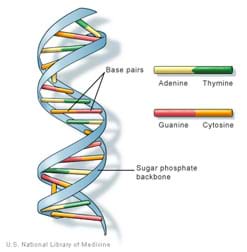
Why is it important to empathize genes and base pair sequences? Have you e'er heard of colour blindness, Down syndrome, cystic fibrosis or hemophilia? Well, biomedical engineers work with others in the scientific and medical fields to help improve health care and quality of life. They study DNA to help us understand genetic disorders like these. Equally engineers develop technologies to recognize certain Dna mutations and where they are located, they work with geneticists to diagnose, care for and forbid these disorders.
Genetic engineers written report genes and Dna to empathize things like DNA replication, cloning and genetically-modified organisms such as nutrient and crops. Genetic engineers have helped us advance our crop technologies and brand synthetic (artificial) insulin for people with diabetes.
DNA can besides identify people — fifty-fifty better than fingerprints. Dna is constitute in all of our cells: pilus, teeth, bones, claret and saliva. We tin can leave our Deoxyribonucleic acid behind when nosotros drink from a cup, use a toothbrush, shed hair or cutting ourselves on something sharp. Because of this, Dna is used for "DNA fingerprinting" — or describing the unique Dna recipe for a person. Even 0.01% difference is enough to distinguish one person from some other when information technology comes to collecting evidence from a crime scene.
Using Dna in a crime investigation does have its limitations. The probability of laboratory error or contagion — errors made when collecting and running the Dna samples — must be factored into the results. It is ever all-time to consider Dna fingerprinting along with other prove. Biomedical engineers create the tools, equipment and processes to accurately collect and examine Deoxyribonucleic acid prove for criminal offense and paternity cases. They are always working to make the laboratory errors fewer and the machines for identifying the gene sequences more accurate.
Today, nosotros are going to practice determining the phenotypes (physical characteristics) of persons from their Deoxyribonucleic acid. Nosotros are going to work together to make models of human DNA and swap them with each other to decode. Like biomedical engineers, permit's pause down DNA gene sequences into individual traits to describe the people to which the Dna belongs.
Procedure
Groundwork
Remind students that DNA is composed of four nucleotide bases: adenine (A), thymine (T), guanine (Grand) and cytosine (C). These four bases pair with each other in a very specific way: A ever pairs with T and Yard e'er pairs with C.
Earlier the Activity
- Assemble materials and make photocopies or printouts (as described next).
- For every three groups (of two students each), impress one re-create of the Dna Build Colour Central; cut along the dotted lines to create three color keys from each sheet.
- Print one copy of the Deoxyribonucleic acid Build Identity Primal and cutting out the xv Dna identity cards (one per group).
- Create an overhead transparency of the DNA Build Identity Fundamental and brandish it on an overhead projector.
With the Students: Role 1
- Split up the class into groups of 2 students each.
- Hand out supplies to each pair of students: one plate, ~25 toothpicks ~30 gumdrops, 1 DNA identity carte du jour and i color central.
- Explicate that the color fundamental contains the three-base genotypes that lawmaking for sure phenotypes (physical characteristics).
- Explain that the Deoxyribonucleic acid identity cards contain the names and physical characteristics of various people, unlike for every squad. This is the person'south Dna that the squad volition construct. Remind students to proceed this person'south identity a secret from the other groups (for now).
- For each physical characteristic on the identity cards (phenotype), refer to the colour key and have groups write downward in columns the sequences of messages (genotypes, using A, T, G and C) for their persons. Then, take students write the corresponding base of operations pairs in second columns. This is where the groundwork knowledge in a higher place volition come into play. A always pairs with T and One thousand always pairs with C. (For example, if the genotype for brown eyes is TGG, you would use the colour code for the gum drops to find the conjugate pairs of ACC.) The associated YouTube video is a great visual resources to evidence this example.
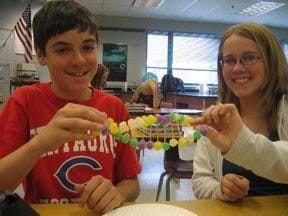
- Allow enough fourth dimension (~fifteen-20 minutes) for teams to build the strand of DNA for their persons. For DNA edifice tips, see Figures 1 and two and the side by side section.
- Once all groups take completed edifice, have them trade Deoxyribonucleic acid strands, and by working backwards from the strand merely (no peeking at the identity cards), each group should decide whose DNA they have (by referring to the possible identities shown with the overhead projector). Students really enjoy this "decoding" part!
- Have students check with the original creator teams of the Dna strands to encounter if they adamant the correct DNA identities. Discuss with the class: How many groups were able to name the right identity for their Dna strands? What fabricated decoding difficult?
Suggested Dna Building Steps
It is easiest to construct the Dna strand by post-obit these steps:
- While referring to the identity card and color central, write downward in a column the base letters (A, T, K and C; genotype) and the corresponding base of operations pairs in a second cavalcade for the beginning concrete feature (phenotype).
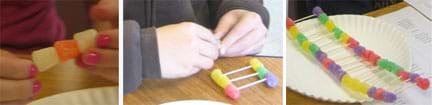
- Next, build each "gene" in the outset column of 3 bases by placing 3 gumdrops (of the correct colors) on 1 toothpick (run across Figure 1a). Refer to the color key.
- Once all five "genes" from ane column are built, repeat the process to build the corresponding base sequences from the second column of messages.
- Connect the base of operations pairs by placing a toothpick betwixt each of the three gumdrops — this creates v "ladders" for each gene (see Figure 1b).
- Now connect all the genes by sticking the end of the toothpicks with the gumdrops together. Exist certain to continue the genes in the correct order and orientation (see Effigy 1c).
- Finally, gently twist the entire strand to shape the double helix (run into Figure two)!
With the Students: Part 2
- Tell the students that they are biomedical engineers working with a city's law section. They have developed a technology that allows them to isolate several cistron sequences in human Deoxyribonucleic acid. The technology has helped them come with the color keys that they used earlier (in Part i).
- The police accept several crime cases in which they need help finding a suspect. They would like to know the phenotype (concrete characteristics) of the person from the DNA samples taken from claret and hair prove. The students' job is to break down the gene sequences in the sample and identify some concrete characteristics of the person. According to their colour keys, what does the person look like? Accept them draw preliminary sketches or descriptions of the persons on bare sheets of paper.
- Sample DNA ane: TGGGCTTAAGGGATA (Answer: Brown eyes, blonde pilus, right-handed, medium height, round nose.)
- Sample DNA ii: TGCGTCTTAGAACAT (Respond: Hazel eyes, reddish hair, left-handed, short height, pointy nose.)
- Sample Deoxyribonucleic acid iii: TGGGTGTAAGGGGTA (Answer: Dark-brown eyes, black hair, right-handed, medium summit, long nose.)
- Conclude by leading a class discussion about biomedical engineering and genetic disorders, equally described in the Assessment section. For this post-activity cess, take students apply their color keys to look at a few more Deoxyribonucleic acid samples for indications of genetic disorders.
Vocabulary/Definitions
biomedical engineer: A person who blends traditional engineering techniques with the biological sciences and medicine to meliorate the quality of human health and life. Biomedical engineers blueprint artificial body parts, medical devices, diagnostic tools, and medical treatment methods.
chromosome: A group of genes; humans have 23 pairs of chromosomes (46 total) in a cell nucleus.
deoxyribonucleic acid: abbreviated DNA. The genetic material for all living things; located in the cell nucleus.
gene: A section of DNA that carries information to make up one's mind characteristics or traits.
genotype: The specific sequence of Deoxyribonucleic acid in a gene.
hazel: Low-cal golden-brownish or xanthous-brown color (every bit the color of a hazelnut).
model: (noun) A representation of something for false, comparing or analysis, sometimes on a different scale. (verb) To make something to help acquire about something else that cannot exist directly observed or experimented upon.
nucleotide bases: The parts of RNA and DNA involved in pairing; they include cytosine, guanine, adenine, thymine (DNA) and uracil (RNA), abbreviated as C, G, A, T and U. They are usually only called bases in genetics. Also called base of operations pairs or bases.
phenotype: The outward, physical characteristic(southward) expressed by a gene sequence.
Cess
Pre-Activity Assessment
Discussion Questions: Inquire the students and discuss every bit a form.
- Why practise we look like our parents? (Answer: Each of us receives genetic information from each of our parents.)
- Where in our bodies is genetic data stored? (Answer: All genetic information is in our Deoxyribonucleic acid, located in the nucleus of each cell.)
Activity Embedded Assessment
Question/Respond: While students are building their DNA strands, ask them the post-obit questions:
- What is Dna? (Respond: DNA is the genetic fabric for all living things.)
- What is a factor? (Answer: A factor is a segment of Deoxyribonucleic acid that codes for a specific trait.)
- Is there a way to have different characteristics with the same Dna sequence? (Answer: No, Dna sequencing is unique for each characteristic.)
- What is DNA fingerprinting? (Respond: DNA fingerprinting is describing a person using DNA show from a biological sample, such as claret, saliva, tissue or hair.)
- Do all humans have the same DNA? Explicate. (Answer: No, humans share virtually 99.99% of Deoxyribonucleic acid. Only identical twins share 100% of their DNA).
- What type of engineer would work with DNA and genes? (Respond: A biomedical engineer.)
- How are engineers involved in DNA and gene sequencing? (Answer: Biomedical engineers study which specific DNA sequences code for sure characteristics in order to recognize genetic disorders such as color blindness, Down syndrome, cystic fibrosis and hemophilia. Engineers pattern technologies that recognize certain Deoxyribonucleic acid mutations and work with geneticists to diagnose and forestall the disorders.)
Postal service-Activity Assessment
Biomedical Engineering and Genetic Disorders Word: Virtually genetic disorders are associated with an alteration of DNA. For example, color blindness can be associated with a single mutation (change) on any of 19 different chromosomes and multiple different genes. These genetic disorders can exist either numerical or structural. Numerical disorders occur when a DNA chromosome is either missing or has an extra copy. For example, Down syndrome is an example in which three copies of a Deoxyribonucleic acid chromosome be, instead of two. Structural disorders occur when a portion of a Dna chromosome is missing or replicated or moved to the incorrect place. Have students discuss how an engineer might be able to develop technologies that look for specific gene changes or mutations in Dna. Using the color key, which of the following Dna samples might take a genetic disorder? What is the alteration? (Note: None of the post-obit examples result in real disorders, but they each illustrate a type of change in the gene sequence of the DNA piece.)
- AGGAGGGCCTAAGGGGTA (Reply: Duplication of the AGG factor.)
- TGGGCTGTTATA (Reply: Deletion of a gene.)
- TGCGTGGTATAAGGG (Answer: Gene in the wrong place. This translocation is usually seen when one chromosome attaches to an entirely unlike chromosome, or portions of two different chromosomes take been exchanged.)
Troubleshooting Tips
Groups may need to trade with other groups from their given gumdrop supply, as the gumdrop colors are different on each color key.
When connecting all the genes together, be certain to keep the genes in the correct lodge and orientation, or else they won't be able to be decoded by another team.
Activity Extensions
Have students research a specific genetic disorder and write a one-folio summary about it, including a description of which chromosome is affected and the associated mutation. Examples include Down syndrome, color blindness, hemophilia and cystic fibrosis.
Activity Scaling
- For lower grades, information technology may assist to build one DNA strand every bit a course before students build on their own. Shorten the action by constructing only ii or three of the five characteristics (for example, merely pilus and heart colour).
References
About R&D - Enquiry & Development. Updated November 27, 2008. GlaxoSmithKline plc. www.gsk.com Accessed March 2, 2009.
Bachor, Kevin. Fun Facts (well-nigh Deoxyribonucleic acid). The Best Detergent for Plentiful Deoxyribonucleic acid Extraction, Cirque du Soleil, Ecole Nationale de Cirque, 2006 Canada Broad Virtual Scientific discipline Fair. http://www.virtualsciencefair.org/2006/bach6k2/Funfacts.htm Accessed March 2, 2009.
Copyright
© 2007 by Regents of the University of Colorado.Contributors
Megan Schroeder; Malinda Schaefer Zarske; Janet Yowell; Denise W. CarlsonSupporting Programme
Integrated Instruction and Learning Program, College of Technology, University of Colorado BedrockAcknowledgements
The contents of this digital library curriculum were developed nether a grant from the Fund for the Improvement of Postsecondary Instruction (FIPSE), U.S. Department of Didactics and National Scientific discipline Foundation GK-12 grant no. 0338326. However, these contents practice not necessarily represent the policies of the Department of Instruction or National Scientific discipline Foundation, and you should not assume endorsement by the federal government.
Terminal modified: June xvi, 2021
Source: https://www.teachengineering.org/activities/view/cub_biomed_lesson09_activity2
0 Response to "Dna Model Online Interactive Easy Middle School"
Post a Comment